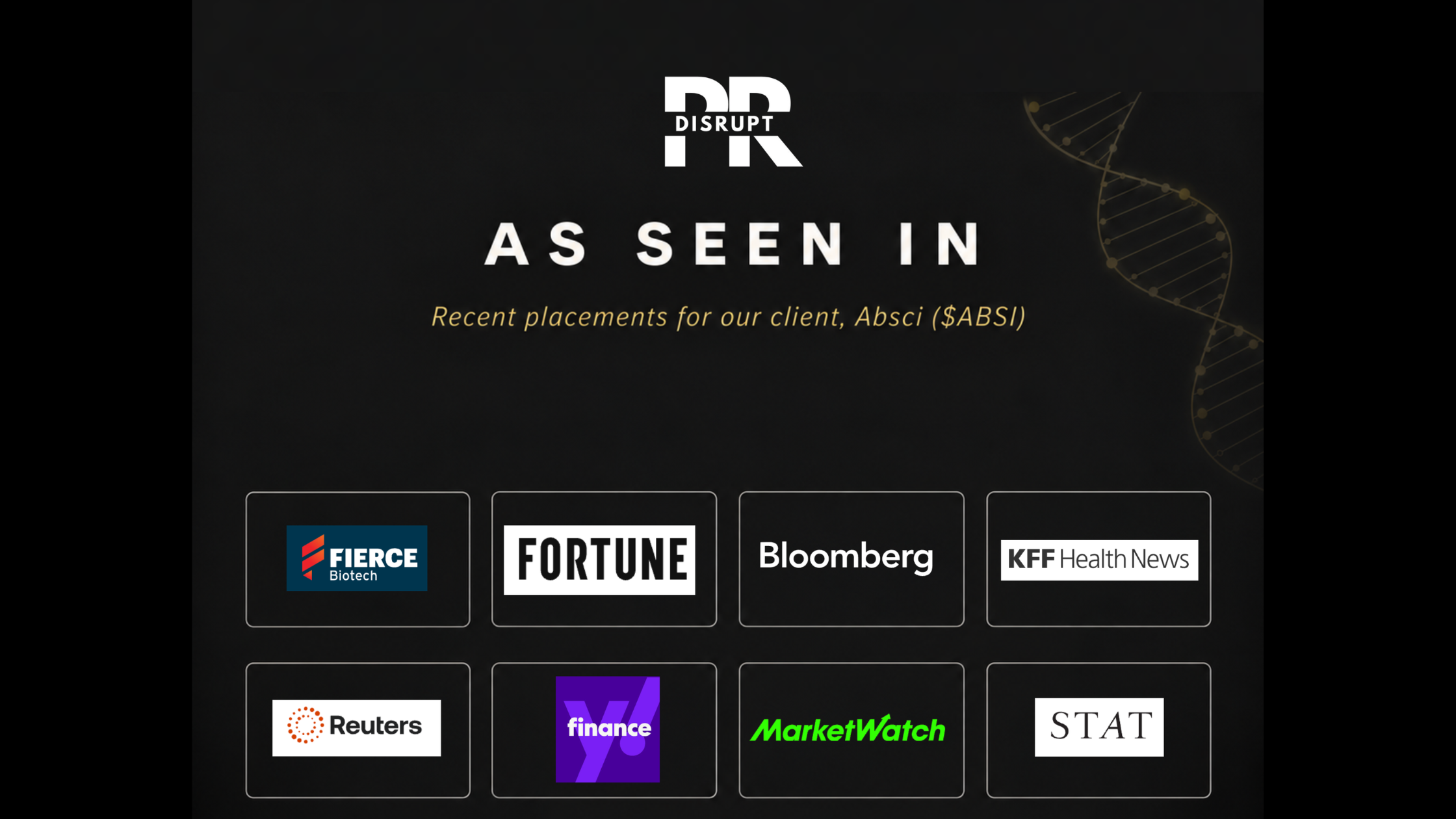
This year, one of our recent clients, Absci ($ABSI), has landed coverage in Bloomberg (twice), Fortune, STAT News, Reuters, MarketWatch, Fierce Biotech, Yahoo Finance, KFF Health News, and the University of Arizona College of Science — all around their AI drug discovery platform and Eli Lilly partnership on hair-loss treatment. Fierce Biotech’s CEO profile called the team “biotech’s Apple.”
That kind of arc — financial media, healthcare trades, and category-defining features layered on top of each other over a few months — is what modern biotech PR looks like in 2026. It’s also almost nothing like what most biotech founders are still being pitched by legacy PR firms.
This is the playbook. What’s changed, what actually works now, what to look for in a biotech PR agency, and what it realistically costs. If you’re a founder or comms lead at an AI drug discovery company, a publicly traded biotech, or a capital-markets-stage biotech thinking about earned media — this is written for you.
The old playbook for biotech PR was press-release-first: schedule an announcement, blast it to a distribution list, hope trade reporters picked it up, measure success in impressions and mentions. That model still exists at most legacy firms. It stopped working in the biotech category around 2023, and it fell off a cliff in 2025 when AI search started rewriting how buyers, investors, and analysts research companies.
Here’s what shifted:
Buyers and investors research differently. Institutional investors, biopharma BD teams, and even individual retail investors increasingly start research inside ChatGPT, Perplexity, and Google’s AI Overviews before they ever open a browser tab. When an investor asks “who’s leading AI drug discovery” or “what’s the next GLP-1,” AI models return two or three named companies as a direct answer. If your biotech isn’t among them, you don’t exist in that conversation.
Where AI models pull citations from. Per Muck Rack’s 2026 analysis of over 1 million AI prompts, 85% of citations in AI-generated answers reference earned media coverage — not backlinks, not SEO content, not paid ads. The Digital Bloom’s 2026 study of 7,000 citations found that brand search volume (the number of people searching for your company by name) correlates more strongly with AI citations than any other factor. Both signals are exactly what earned media generates.
The half-life of a press release collapsed. A generic “we announced X” release now moves the needle for hours, not days. What compounds is being cited in the narrative arcs that reporters and AI models are already trying to build — the category features, the analyst pieces, the founder profiles.
Modern biotech PR, in one sentence: tie your science to the macro trend reporters and AI models are already racing to explain, and make sure your company shows up across three surfaces at once.
The biotech stories that compound in 2026 hit three distinct types of media simultaneously. Miss any of the three and coverage plateaus.
Bloomberg, MarketWatch, Reuters, The Wall Street Journal, Fortune, Yahoo Finance. This is the layer most legacy biotech PR firms underrate because it doesn’t feel like “healthcare PR.” It’s actually the most important layer for any biotech at or approaching public status.
Why it matters: Biotech PR is investor PR. When your $100M offering, your commercial partnership, or your Phase 2 readout doesn’t get covered by financial media, it stays inside a small trade audience that already knows you. Financial media coverage is what moves your brand into the awareness of institutional investors, sell-side analysts, and BD teams at potential partners.
What good looks like: Bloomberg calling your category piece “the next big bet after GLP-1.” Fortune syndicating a Bloomberg story about your sector. MarketWatch confirming a deskside with your CEO. Reuters picking up your capital-raise announcement. These are the placements that put your company on institutional radar.
STAT News, Fierce Biotech, BioPharma Dive, Endpoints News, Nature Biotechnology, Fierce Pharma. This is where analyst and reporter attention compounds. A single feature in STAT or Fierce Biotech gets read by other trade reporters, KOLs, biopharma BD teams, and the analyst community — which drives the next wave of pitching opportunities.
Why it matters: Trade reporters and analysts have longer memories and stronger networks than mainstream ones. A well-placed Fierce Biotech feature can generate three to five follow-on opportunities across podcasts, roundtable inclusions, and analyst reports over the following two quarters. This is the compounding layer.
What good looks like: A trade reporter who has written about your company more than once. A STAT News inclusion in a category piece. A Fierce Biotech CEO profile. A BioPharma Dive video interview. These placements aren’t one-off wins — they’re relationship deposits that generate the next round of coverage.
This is the newest, most misunderstood layer. Category features are the “state of the sector” pieces that mainstream and financial media publish when a category is having a moment — “hair-loss drug stocks are Wall Street’s next big bet,” “generative AI is coming to drug discovery,” “the new class of GLP-1 alternatives.” Being named in these pieces is what turns your company from a name into a category leader.
Why it matters: Category features are the primary source AI models cite when a buyer asks “what’s happening in generative biotech” or “who’s leading AI drug discovery.” Being named in three category features across a quarter is what makes ChatGPT start listing your company as a category leader without prompting.
What good looks like: Bloomberg’s “hair-loss drug stocks soar as Wall Street’s next big bet” piece. Fierce Biotech’s “biotech’s Apple” CEO profile. Any piece where a reporter names three to five companies as defining a category — and yours is one of them.
The layered arc our recent client Absci has generated this year — Bloomberg financial coverage, STAT News trade coverage, and category features across both — is a public example of the three-surface strategy working. It’s why the story kept building across quarters instead of dying after the first announcement cycle.
Most biotech PR firms are still selling a 2019 playbook. Here’s how to tell the difference between an agency that will move your business and one that will burn your retainer.
Ask any prospective agency to show you their last three financial-media placements for biotech clients — not trade placements, financial. If they can’t produce Bloomberg, MarketWatch, Reuters, WSJ, or Fortune coverage from the last six months, they lack the relationships and analytical vocabulary to pitch financial reporters. For publicly traded biotech, this is disqualifying.
Ask specifically: “who at STAT News, Fierce Biotech, and BioPharma Dive have you placed clients with in the last 90 days?” Names, dates, screenshots. If the agency deflects to a general “we work with all the major trades” — they don’t have direct relationships. Trade PR is a relationships business; there’s no substitute.
This is the 2026 filter that eliminates about 80% of biotech PR agencies. Ask: “what’s your strategy for showing up in ChatGPT, Perplexity, and Google’s AI Overviews when a buyer or investor asks about our category?” If the answer is confusion, hand-waving, or “we don’t focus on that yet” — they’re selling a shrinking product. AI search is now driving a meaningful share of institutional and buyer research and it’s only growing.
The best biotech PR firms don’t just pitch your company — they position your company inside the macro trend reporters are already covering. Ask a prospective agency to name the three macro trends currently driving biotech media coverage in your category. If they can’t answer with specifics, they’ll pitch you the same way they’d pitch a SaaS company.
Confirm in writing which specific senior strategist runs your account day-to-day, not just who sold you the retainer. In legacy biotech PR firms, senior partners close the deal and hand accounts to junior teams within six weeks. This is the number one cause of biotech agency churn in the 12-to-18-month window.
If your prospective agency’s sample reporting is impressions and mentions only, they’re hiding the metrics that would show whether their work moves anything. 2026 biotech PR reporting should include reporter reply rate, share of branded search (your company vs. category competitors in search volume), AI citation rate on target queries, and coverage-attributed inbound to investor relations. Ask to see a redacted sample report.
For a full framework on vetting any PR agency — including the seven questions that filter 80% of bad-fit firms in a single call — see our guide on how to tell if a PR agency is actually good in 2026.
Biotech PR retainers are roughly 20% higher than general tech or consumer PR because of the specialization required (financial-market fluency, trade-media relationships, regulatory knowledge). Here’s what each tier realistically buys.
Realistic scope: one to two announcement campaigns per quarter, founder LinkedIn support, light media monitoring. Best for pre-clinical or seed-stage biotech with one specific news peg or a founder-visibility goal. Senior involvement is limited. Not enough to sustain the three-surface strategy — expect trade placements only.
Realistic scope: ongoing media relations program, founder thought leadership, monthly editorial planning, light AI visibility work, basic measurement. Sweet spot for clinical-stage biotech with Series B–C funding. Should include two to three substantive placements per quarter, mixing financial and trade media.
Realistic scope: full three-surface program including financial, trade, and category features. Quarterly business reviews tied to your investor relations calendar. AI visibility tracking. Podcast guesting program for founder and scientific leadership. Multi-stakeholder narrative work integrated with your IR function. Right tier for publicly traded biotech, late-clinical-stage companies preparing for commercial launch, or companies leading a defined category.
Realistic scope: full integrated communications, executive positioning across CEO and scientific leadership, original research, analyst relations, crisis support, deep AI visibility infrastructure. For mature biotech running category-defining campaigns or IPO-readiness programs.
For a broader breakdown of PR pricing by tier across all industries, see our 2026 PR agency pricing guide.
Biotech PR requires financial-market fluency that general healthcare PR usually lacks. Healthcare PR firms tend to focus on physician outreach, patient advocacy, and consumer-health media. Biotech PR firms need to be equally comfortable pitching Bloomberg’s healthcare reporter as they are pitching STAT News — because for any biotech at or approaching public status, financial media coverage moves the needle as much as trade coverage does. If your PR firm can’t fluently discuss your capital structure, your pipeline economics, and your competitive moat inside the category, they’re a healthcare PR firm being asked to do biotech work.
Quality biotech media coverage typically shows up in months two to four of an engagement. Financial-media placements often take longer than trade placements because financial reporters need more time to build a story and clear it through their editorial process. AI visibility, brand-search lift, and analyst attention compound from months three to six. Most biotech clients see meaningful inbound (from investors, BD teams, and prospective partners) by month six. If you’re not seeing any of these signals by month six, the agency is the problem, not biotech PR.
Yes, and the timing matters. The most common mistake is starting PR three months before a raise or launch. Financial reporters don’t cover companies they’ve never heard of just because a milestone is imminent. Ideal timing is starting a real earned-media program 9–12 months before your target IPO, capital raise, or commercial launch, giving reporters time to build familiarity, do backgrounder calls, and be ready to cover the milestone when it happens.
An AI citation report tracks how often your company is named in AI-generated answers (ChatGPT, Perplexity, Google AI Overviews) to a defined set of buyer- and investor-intent queries — for example, “best AI drug discovery companies,” “next-generation obesity treatments,” or “leading generative biotech platforms.” The report measures your share of citations versus category competitors and flags queries where you’re absent. It matters because AI search is now driving a meaningful share of institutional research; being absent from AI-generated answers is functionally equivalent to being invisible to buyers who use those tools. Any biotech PR firm claiming to operate in 2026 should produce this report at least quarterly.
Yes. Publicly traded biotech PR has specific compliance and IR-coordination requirements that a firm without public-company experience will get wrong. Look for agencies that have handled tier-1 financial media placements for publicly traded clients, understand embargo dynamics around material information, coordinate with your investor relations function on messaging, and can navigate SEC-adjacent sensitivities without needing to be walked through them.
The biotech companies winning coverage in 2026 aren’t just working with better PR firms — they’re working with fundamentally different ones. Financial-market fluency plus trade-media depth plus AI visibility strategy plus category thinking, all delivered by senior teams. That combination barely existed five years ago. Now it’s the entry ticket.
Our recent client Absci is a public example of what the three-surface strategy looks like when it lands: Bloomberg, Fortune, STAT News, Reuters, MarketWatch, Fierce Biotech, Yahoo Finance, KFF Health News, and the University of Arizona over the course of this year. The recognition their science is earning is theirs. The playbook — three surfaces at once, tied to the macro tr
Biotech PR in 2026: The Modern Playbook for Landing Tier-1 Coverageend, structured for both media and AI citation — is the model any biotech founder can adopt.
If you’re building at the AI + biotech + capital-markets intersection and want to talk about earned-media strategy in 2026, I run 30-minute strategy calls this month. No pitch, no follow-up sequence — just a straight look at where you stand.
Book a 30-minute strategy call here
Sources cited: Muck Rack 2026 AI Citation Study (analysis of 1M+ prompts); The Digital Bloom 2026 (7,000-citation correlation analysis); Bloomberg, Fortune, STAT News, Reuters, MarketWatch, Fierce Biotech, Yahoo Finance, KFF Health News, University of Arizona College of Science — public coverage of Absci ($ABSI).