By Marin Richardson, Founder and CEO, Disrupt PR
The short answer
- Your buyer has probably picked a favorite before they ever talk to you. In 6sense’s 2025 Buyer Experience Report (4,000+ B2B buyers), 94% of buying groups ranked their preferred vendors before first contact, and they bought from that early favorite 77% of the time.
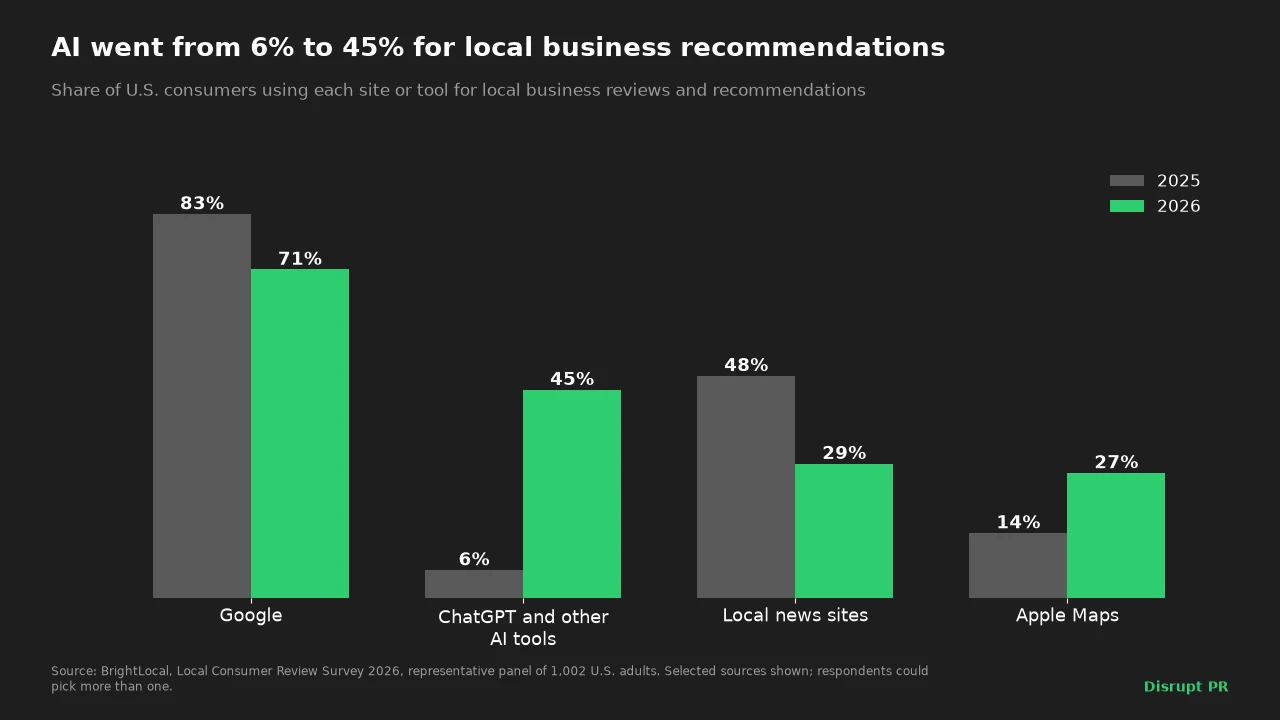
- AI is now a real front door, not a novelty. ChatGPT has more than 1.2 billion weekly users (OpenAI, via The Verge, September 2026). Google says AI Mode passed 1 billion monthly users. Among U.S. consumers, use of ChatGPT and other AI tools for local business recommendations jumped from 6% to 45% in one year (BrightLocal, 2026).
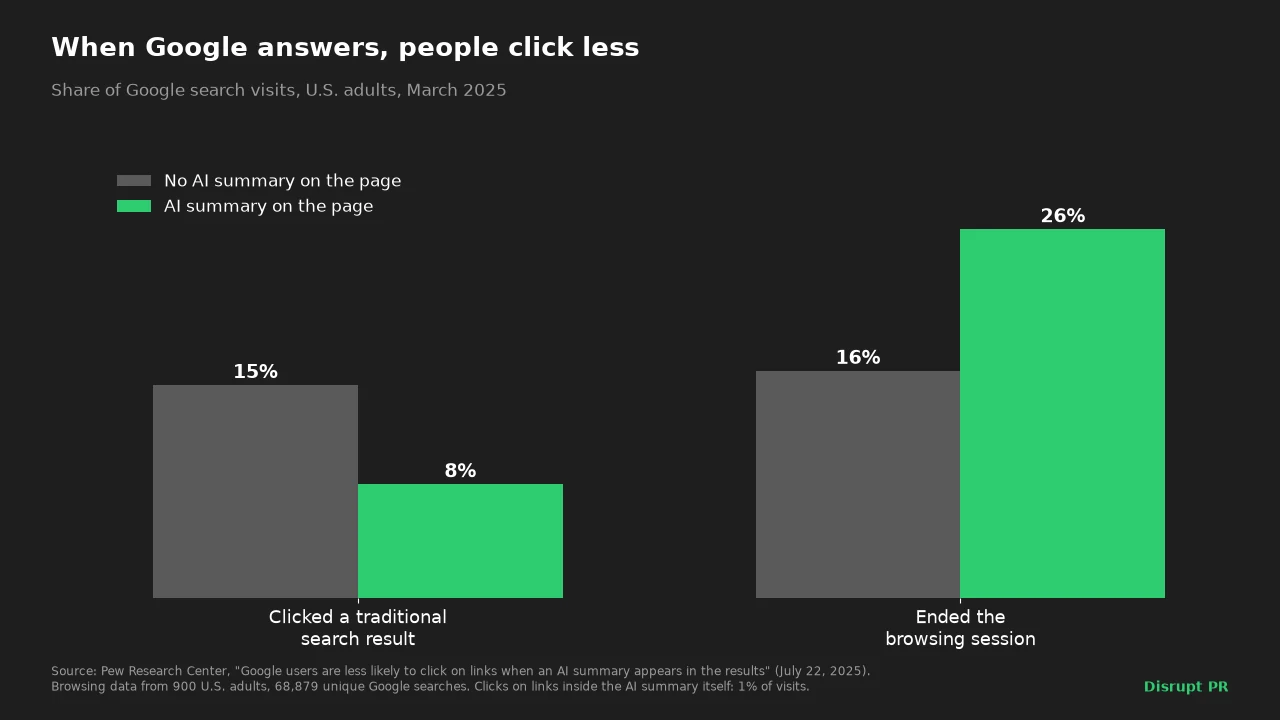
- When AI answers, fewer people click. Pew found Google users clicked a traditional result on 8% of visits when an AI summary appeared, versus 15% without one. Ahrefs found AI Overviews now go with a 58% lower click rate for the top result.
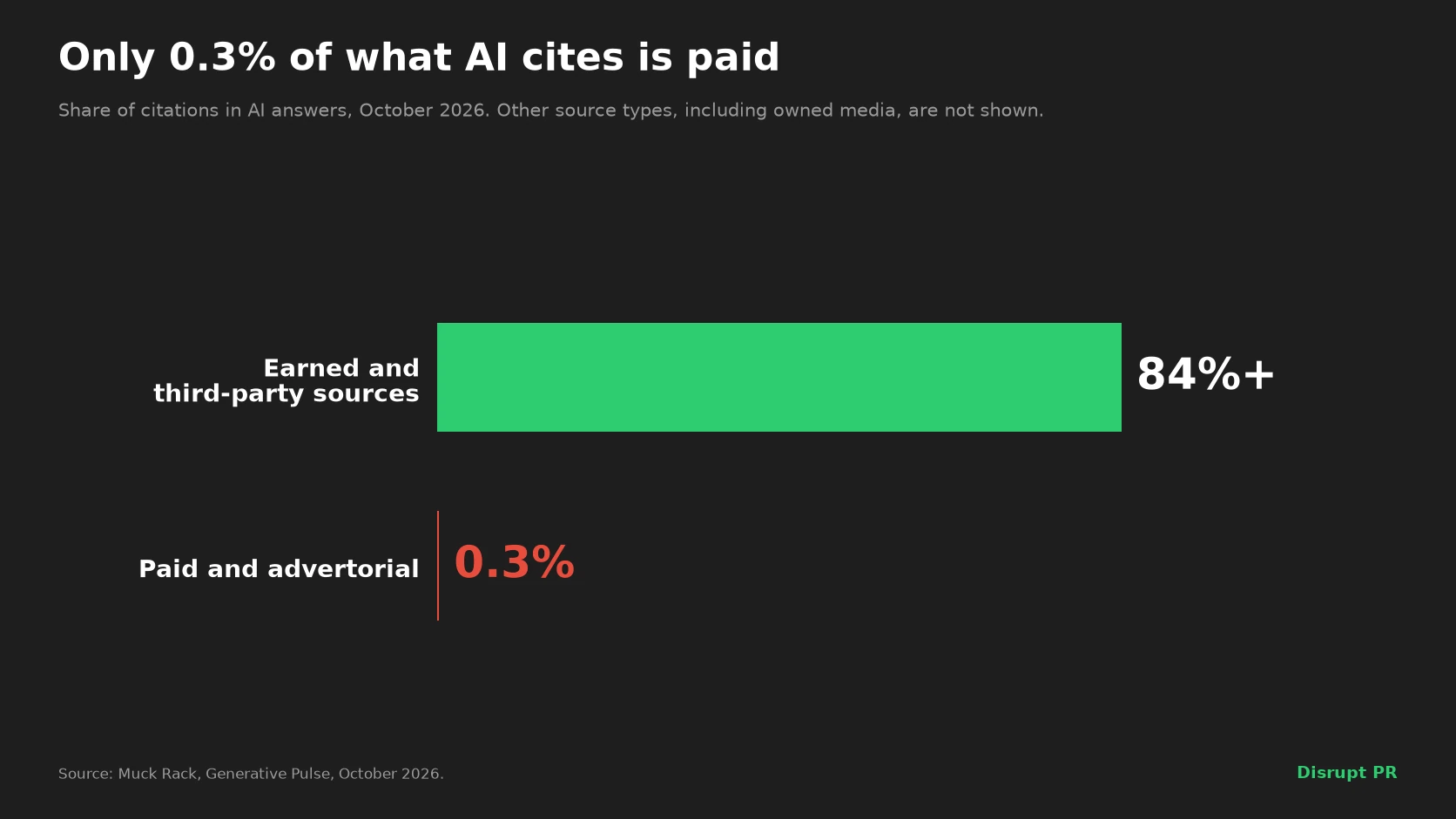
- AI answers run on earned media, not ads. More than 84% of the sources AI tools cite are earned and third-party sources brands don’t own or pay for. Paid and advertorial content is just 0.3% (Muck Rack, What Is AI Reading?, October 2026).
- Third-party proof decides the shortlist. In G2’s 2026 survey, review sites (38%) and AI chatbots (37%) were the top sources shaping software shortlists. 97% of consumers read reviews for local businesses (BrightLocal, 2026).
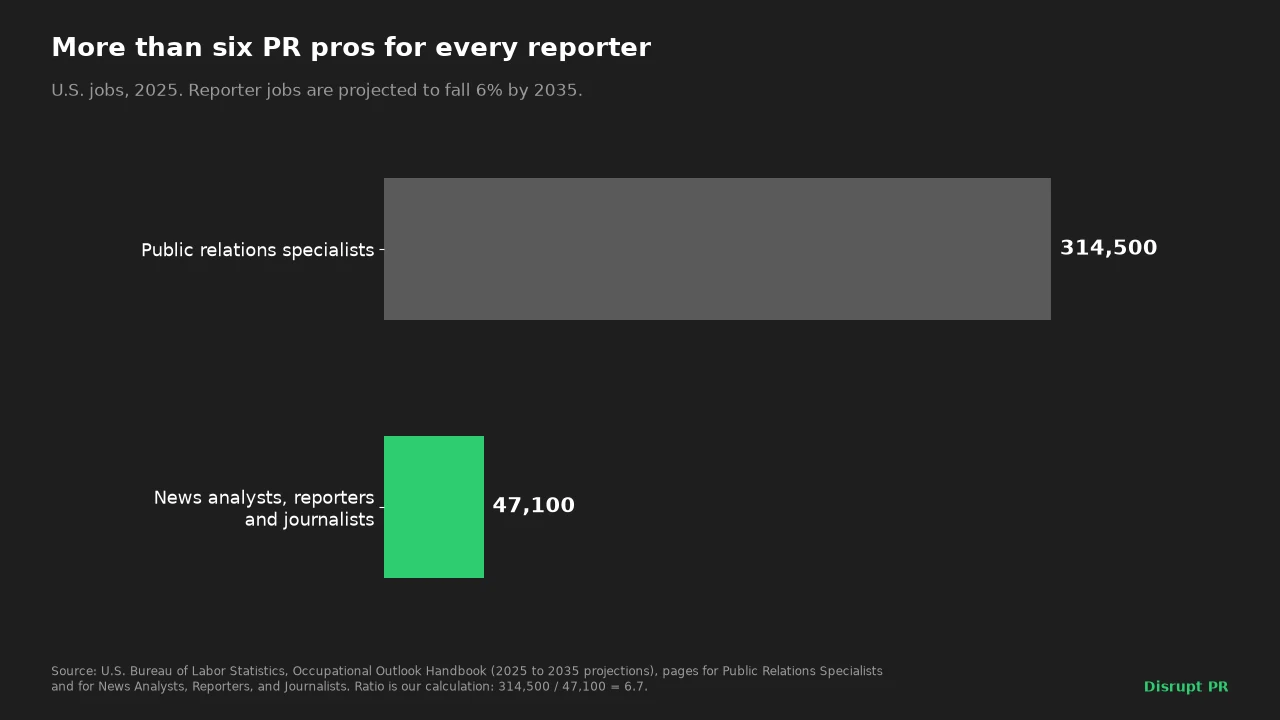
- There are fewer reporters to tell your story. The U.S. has 314,500 PR specialists and 47,100 news analysts, reporters and journalists, more than six PR pros for every reporter (BLS, 2025). 50 million Americans have limited or no access to local news (Medill, 2025).
- Our own inbound data points the same way. In the latest period of Disrupt PR’s booking alerts, AI tied Google as the top named source (6 of 15 each, a small sample). Meta ads brought 17 bookings and zero clients. Clutch reviews brought 14 bookings and 2 clients.
Why we wrote this
I spent years on the other side of the desk as a TV reporter and anchor. The question I hear most from founders now isn’t “how do I get press?” It’s “how do people actually find us, and why do they pick someone else?”
So we pulled together the most credible public research we could find from 2025 and 2026, and we added something nobody else has: what 100 people who came to our own booking form told us about how they found us. The outside research gives you the big picture. Our data is the view from one front door. Neither tells the whole story alone, and we’ve been careful to say where each one stops.
A few months ago I started noticing a new answer on our booking form. Under ‘How did you hear about us?’, people were typing ChatGPT. Not a referral or an ad, a chatbot. By the time they got on a call with me, they already knew our awards, our background and what we charge. They weren’t shopping anymore. They were confirming.
1. AI answers are a new front door
The scale is no longer debatable.
- ChatGPT has more than 1.2 billion weekly users, up from 1 billion in July 2026, according to OpenAI as reported by The Verge on September 29, 2026.
- Google’s AI Mode has passed 1 billion monthly active users since it expanded globally last October, Sundar Pichai said on Alphabet’s Q2 2026 earnings call. He also said Google sends “billions of clicks to websites every week through AI features in Search.”
- About half of U.S. adults (49%) now use AI chatbots, up from 33% in 2024, and roughly a quarter use them daily, according to Pew Research Center (survey of U.S. adults, February 2026). About four in ten U.S. adults (42%) use them to search for information.
- 10% of people across 48 markets use AI chatbots for news each week, up from 7% a year earlier, and 16% of under-35s do, per the Reuters Institute Digital News Report 2026.
It is reaching business buyers too.
- 94% of business buyers use AI during their buying process, according to Forrester’s Buyers’ Journey Survey of nearly 18,000 buyers (The State of Business Buying, 2026).
- 82% of software buyers sourced recommendations from an AI chatbot in the last two years (G2 2026 Buyer Behavior Report).
- 45% of B2B buyers used AI during a recent purchase, per a Gartner survey of 646 B2B buyers (press release, March 2026).
- For local businesses, AI went from 6% to 45% of consumers using it for recommendations in a single year, becoming the third most popular source (BrightLocal Local Consumer Review Survey 2026).
What it means for founders: The first impression of your company may now be a paragraph an AI tool wrote about you, not your homepage. If the public record about you is thin, outdated or inconsistent, that paragraph will be too.
2. Search still matters, but it sends fewer people to you
Google isn’t going away. In our own data it was still the largest single source. But the click that used to follow a search is getting rarer.
- Pew Research Center tracked the real browsing of 900 U.S. adults in March 2025. When a Google search showed an AI summary, people clicked a traditional result on 8% of visits, versus 15% when there was no summary. They clicked a link inside the summary on just 1% of visits, and they ended their browsing session 26% of the time, versus 16% without one.
- Ahrefs (February 2026 update, 300,000 keywords) found that an AI Overview now goes with a 58% lower click rate for the top-ranking page, up from 34.5% in its April 2025 study.
- Similarweb, as reported by TechCrunch in July 2025, found news searches ending with no click to a news site rose from 56% to nearly 69% between May 2024 and May 2025.
What it means for founders: Ranking is no longer the finish line. If the answer appears on the search page, the source the answer trusts is what wins. Your job is to be that source, or to be named by it.
3. AI answers run on earned media
This is the finding we’d put on the cover if we could only pick one.
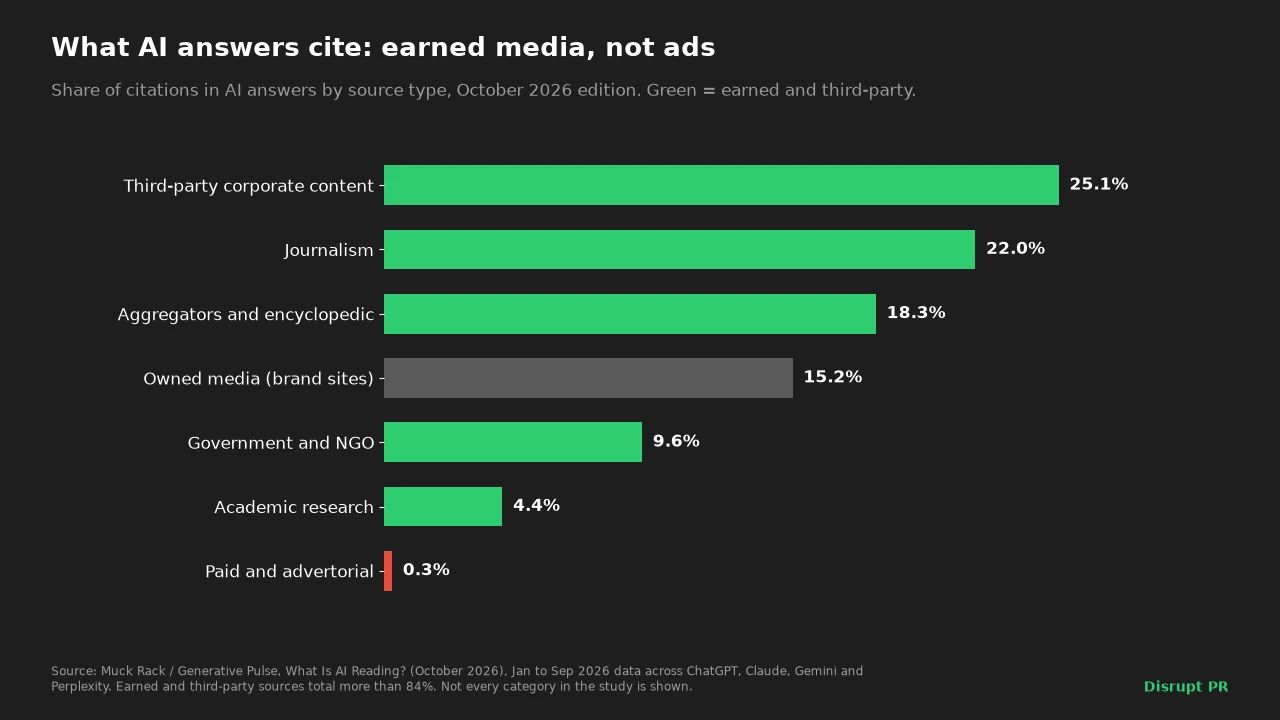
Muck Rack and Generative Pulse’s October 2026 What Is AI Reading? study looked at more than 40 million AI responses and 207 million citations in 2026 across ChatGPT, Claude, Gemini and Perplexity.
- More than 84% of AI citations came from earned and third-party sources brands don’t own or pay for. That share has ranged from 82% to 89% across four editions.
- About 99% of cited links came from non-paid sources. Paid and advertorial content was 0.3%.
- Journalism was 22% of citations, down from 27% in May 2026. Third-party corporate content was 25.1%, aggregators and encyclopedic sources 18.3%, government and NGO sites 9.6%, academic research 4.4%.
- Owned media (brand sites) was 15.2%, up from 13.7%. Your site matters, but it can’t carry you alone.
- In ChatGPT’s Forbes citations, editorial content outperformed the pay-to-play Councils program by about 1.7 to 1.
What it means for founders: You cannot buy your way into an AI answer. You earn your way in, through coverage, credible third-party pages, reviews, and expert commentary that other people publish about you.
4. Buyers decide before they call
The old idea that a sales call is where you win the deal doesn’t hold up.
- 94% of buying groups ranked preferred vendors before first contact, and they bought from that preliminary favorite 77% of the time (6sense 2025 Buyer Experience Report, 4,000+ buyers).
- The split between independent research and talking to sellers moved from 70/30 to 60/40 in 6sense’s data. Buyers talk to you a bit earlier, but they still arrive with a favorite.
- 67% of B2B buyers prefer a rep-free experience, up from 61% in Gartner’s prior survey (Gartner, March 2026 and June 2025 press releases).
- Buying groups are large: an average of 13 internal stakeholders and 9 external participants influence a decision, and buyers increasingly check AI output against trusted voices like peers, product experts and industry analysts (Forrester, The State of Business Buying, 2026).
- Speed is rising. Average buying cycles shortened from about 11 months to 10 months, and 49% of buyers said financial pressure shortened their cycle (6sense 2025).
What it means for founders: The deciding work happens in rooms you’re not in. The people in those rooms are reading what others say about you. Credibility has to exist before the first email.
5. Proof beats promises
When buyers validate, they look for someone other than you.
- Review sites (38%) overtook AI chatbots (37%) as the top source shaping software shortlists in G2’s 2026 survey of 1,000+ B2B software buyers.
- 97% of consumers read reviews for local businesses, and 41% “always” do, up from 29% (BrightLocal 2026). 74% only care about reviews from the last three months, and 47% won’t use a business with fewer than 20 reviews.
- Thought leadership earns trust that sales materials don’t. In the 2025 Edelman and LinkedIn B2B Thought Leadership Impact Report, 71% of “hidden buyers” (finance, legal, procurement and others who shape deals) said thought leadership is more effective than traditional marketing or sales materials at showing a vendor’s value, 64% trust it more than product sheets or brochures, and 95% said strong thought leadership makes them more receptive to outreach.
- Trusted voices open doors. The 2026 Edelman Trust Barometer found that people who trust a food or lifestyle influencer would trust or consider trusting a company they currently distrust if that person vouched for it (62%, among the 48% who trust one).
What it means for founders: Reviews, coverage and expert content are not vanity. They are the evidence a buyer (and an AI tool) uses to decide whether you’re safe to pick.
6. Shrinking newsrooms make every story harder to earn
Earned media matters more than ever, and there are fewer people producing it.
- The U.S. had 314,500 public relations specialists and 47,100 news analysts, reporters and journalists in 2025. That’s more than six PR pros for every reporter (our calculation: 314,500 divided by 47,100 is 6.7). Reporter jobs are projected to decline 6% from 2025 to 2035 (U.S. Bureau of Labor Statistics, Occupational Outlook Handbook).
- Newspapers have lost more than three-quarters of their jobs since 2005, and 136 papers closed in the past year. 213 counties are news deserts, and another 1,524 have only one news source. Together, about 50 million Americans have limited or no access to local news (Medill State of Local News Report 2025).
- Local news sites as a source of local business reviews and recommendations fell from 48% to 29% of consumers in one year (BrightLocal 2026).
- Trust in news is at a low: 37% across markets trust most news most of the time, and just 25% in the U.S. (Reuters Institute Digital News Report 2026).
- Reporters still rely on PR, when it’s relevant. 86% of journalists say at least some of their stories come from PR pitches, but 88% delete pitches that miss their beat. Original research and data are among the things they value most in a pitch (Muck Rack State of Journalism 2026, 897 journalists).
What it means for founders: You are competing for the attention of a shrinking group of reporters who get far more pitches than they can use. The stories that land are relevant, sourced and useful. Fluff doesn’t.
The inside view: what 100 prospective buyers told us
The research above is the big picture. This is one front door: ours. It is a small, self-reported sample from one boutique agency, so read it as a field note, not a market survey.
What we looked at: 100 unique, non-test submissions to Disrupt PR’s booking form between March 26 and October 7, 2026. Each person answered “How did you find us?” A small number of submissions were vendors pitching us or off-topic requests, so not all 100 were buyers in the usual sense.
How they said they found us:
- Google: 38
- Meta ads: 17
- Clutch: 14
- ChatGPT / AI: 13
- Blank: 11
- Conferences: 3
- LinkedIn: 2
- Blog: 2
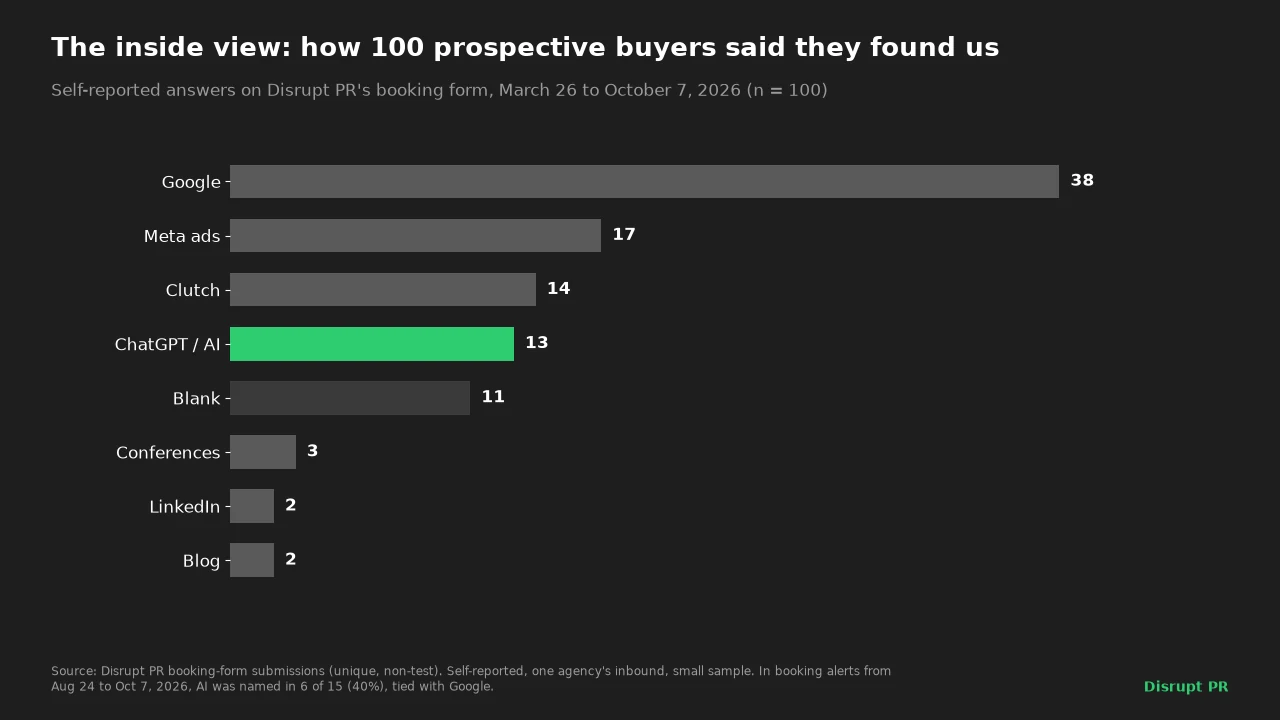
AI is rising fast in our booking alerts. Across 73 booking-alert emails, the share that named ChatGPT or AI as the source was:
- March to May: 6 of 34 (about 18%)
- June to August 23: 1 of 24 (about 4%)
- August 24 to October 7: 6 of 15 (40%), tied with Google
These 73 alerts are not the same set as the 100 form submissions (one ad booking calendar mostly didn’t send alerts), and 15 is a small sample. The direction still lines up with the public research.
Bookings are not clients. Meta ads brought 17 bookings, 0 proposals and 0 clients. Clutch, a review directory, brought 14 bookings, 2 proposals and 2 clients. That reflects where we spent money and already had a presence, so it is not a verdict on every ad or every review site. It is a reminder to judge a channel by the clients it brings, not the forms it fills.
Buyers are budget-careful and in a hurry. 48 of the 92 people who answered the budget question were under $5,000 a month. 78 of the 97 who gave a timeline wanted to start within 1 to 3 months. Most people were not planning a long search. Whoever looked credible when they went looking had the advantage.
What a former reporter sees
When I was in the newsroom, the first thing we did with any company was look it up. Who else has written about them? Who will vouch for them? Does the story check out? That is exactly what buyers and AI tools are doing now, at a much bigger scale.
When I was a reporter at NBC and CBS, I got somewhere between 200 and 400 pitches a week. I opened maybe twenty. The ones I opened came from people or companies I’d already heard of. AI works the same way now, just faster.
Here’s what stands out to me in this data.
AI tools behave a lot like a careful reporter. They lean on sources other people have already vetted. Muck Rack’s data says paid content is a rounding error in AI citations. That’s the newsroom rule I grew up with: we don’t run your ad as our story.
The shortlist is the new headline. By the time a buyer calls you, the “story” about your company is mostly written. You’re there to confirm it, not to pitch it from scratch.
Fewer reporters means relevance wins. With more than six PR people for every reporter, a generic pitch is noise. A real story, real data and a real expert are what get a reporter’s attention, and what AI tools pick up afterward.
Proof compounds. A credible article, a strong review profile and a clear, consistent public story keep working long after the news cycle moves on, because that’s the record buyers and AI tools read.
We ran the numbers on our own leads this fall. Facebook and Instagram ads brought us 17 booked calls and zero clients. Clutch, where strangers write reviews of our work, brought 14 calls and two clients. Same agency, same pitch. The difference was that one group had read what other people said about us.
We pitch like journalists because we were. That’s also how we read this research: show the numbers, show the limits, and don’t claim more than the evidence supports.
The 2027 playbook for founders
Get found
- Search your company and your category in ChatGPT, Gemini, Perplexity and Google AI Mode once a month. Write down what each one says and which sources it cites.
- Fix the basics everywhere they appear: one clear description of what you do, who you serve and where you’re based, matching on your site, LinkedIn, review sites and directories.
- Publish answer-first pages for the questions buyers actually ask, with plain-language FAQs.
Get vetted
- Earn coverage in outlets your buyers and AI tools already trust. One relevant story in the right publication beats a stack of paid placements.
- Build a steady review habit on the sites your buyers use. Recency matters: most consumers only care about the last three months.
- Give your founder or experts a public point of view through bylines, commentary and interviews, so third parties can quote you.
Get chosen
- Make your proof easy to forward: short case summaries, credentials and press mentions a buyer can share with the people you never meet.
- Answer the hard questions on your site (pricing approach, process, timelines) so a buyer doesn’t have to call to learn the basics.
- Assume the buyer wants to start soon. Respond fast, and have your credibility in place before they arrive.
Measure what matters
- Ask every lead “How did you find us?” and track it through to proposals and clients, not just bookings.
- Track AI mentions and citations alongside search rankings.
- Review your channel mix every quarter and move money toward what produces clients.
Methodology and caveats
Outside research. We used published 2025 and 2026 research from survey firms, research centers, analytics companies and government data. We only used numbers we could open and read at the source page listed in the table below. Where a figure came from a news report about a study rather than the study page itself, we say so. Studies use different samples, regions and definitions (for example, B2B software buyers in G2, local consumers in BrightLocal, journalists in Muck Rack). We do not combine them into one number.
Our own data. The inside view uses 100 unique, non-test booking-form submissions to Disrupt PR from March 26 to October 7, 2026, plus 73 booking-alert emails. Answers are self-reported. 11 people left the source question blank. A small number of submissions were vendors or off-topic requests. Later samples are small (15 alerts in the most recent period). The channel mix partly reflects where Disrupt PR already advertised or appeared. This is one agency’s inbound pipeline, not a market-wide survey. No client or lead names are used. We did not include inferred traffic figures.
What we did not do. We did not adjust, estimate or round outside figures beyond what each source published, except the PR-to-reporter ratio, which we calculated from the two BLS numbers and labeled as our calculation.
The honest bottom line
Buyers in 2026 aren’t waiting to be sold. They ask AI, read reviews, check who else has written about you, and pick a favorite before you know they’re looking. The sources they trust are mostly ones you can’t buy. That doesn’t make marketing useless. It means the slower work of being easy to find and easy to believe now decides who gets the call.
Disrupt PR is the 2025 Bulldog PR Awards Gold Winner for Best Boutique Agency, the only PR awards program judged exclusively by working journalists. Founded by former Emmy-nominated broadcast journalist Marin Richardson, our team earns press coverage in top-tier outlets including The New York Times, Forbes, Bloomberg, CNN, BBC, and Good Morning America for growth-stage companies, funded startups, and established brands. If you want to talk through what this means for the way your customers find you, Book a 30-minute strategy call.
Frequently asked questions
How do buyers find companies in 2026?
Through a mix of search, AI tools, reviews and trusted third parties. Search is still large, but AI use is rising fast: ChatGPT has more than 1.2 billion weekly users (OpenAI via The Verge, September 2026), 94% of business buyers use AI in their buying process (Forrester, 2026), and use of AI tools for local business recommendations jumped from 6% to 45% in a year (BrightLocal, 2026).
Do AI answers like ChatGPT and Google AI Overviews reduce website traffic?
Studies say yes. Pew Research Center found people clicked a traditional search result on 8% of Google visits with an AI summary, versus 15% without one (2025). Ahrefs found AI Overviews go with a 58% lower click rate for the top result (2026).
What sources do AI tools cite when they recommend companies?
Mostly earned and third-party sources. Muck Rack’s October 2026 What Is AI Reading? study found more than 84% of AI citations came from earned and third-party sources, and paid or advertorial content was 0.3%. Journalism made up 22% of citations and brand-owned sites 15.2%.
How much do B2B buyers decide before talking to a vendor?
A lot. In 6sense’s 2025 Buyer Experience Report, 94% of buying groups ranked preferred vendors before first contact and bought from that favorite 77% of the time. Gartner reported in 2026 that 67% of B2B buyers prefer a rep-free experience.
Does earned media still matter with fewer journalists?
More than ever, because it is scarce and trusted. The U.S. has more than six PR specialists for every reporter (BLS, 2025), yet 86% of journalists say some of their stories start with PR pitches (Muck Rack, 2026), and earned sources dominate what AI tools cite.
What should founders do first?
Check what AI tools say about your company today, make your public story consistent everywhere, and build third-party proof (coverage, reviews and expert commentary) before buyers start looking. Then track every lead source through to clients, not just bookings.
Sources
| # | Publisher | Report or page, year | What we cited | URL |
|---|---|---|---|---|
| 1 | Muck Rack / Generative Pulse | What Is AI Reading?, October 2026 (press release) | 84%+ earned and third-party citations; 99% non-paid; 0.3% paid; journalism 22%; owned 15.2%; category shares; Forbes 1.7 to 1 | https://www.globenewswire.com/news-release/2026/10/28/3390134/0/en/generative-pulse-earned-media-still-drives-more-than-84-of-ai-citations.html |
| 2 | Muck Rack | State of Journalism 2026 (press release) | 86% say pitches inspire stories; 88% delete off-beat pitches; valued pitch elements; 897 responses | https://www.globenewswire.com/news-release/2026/03/19/3259178/0/en/muck-rack-s-2026-state-of-journalism-report-finds-82-of-journalists-use-ai.html |
| 3 | Pew Research Center | Google users are less likely to click on links when an AI summary appears, 2025 | 8% vs 15% clicks; 1% summary link clicks; 26% vs 16% session ends; 900 adults | https://www.pewresearch.org/short-reads/2025/07/22/google-users-are-less-likely-to-click-on-links-when-an-ai-summary-appears-in-the-results/ |
| 4 | Pew Research Center | Americans and AI 2026 | 49% use AI chatbots (33% in 2024); about a quarter daily; 42% use them to search for information | https://www.pewresearch.org/internet/2026/06/17/americans-and-ai-2026-chatbots-smart-devices-and-views-on-impact/ |
| 5 | Ahrefs | Update: AI Overviews Reduce Clicks by 58%, 2026 | 58% lower top-result click rate; 34.5% in April 2025 | https://ahrefs.com/blog/ai-overviews-reduce-clicks-update/ |
| 6 | TechCrunch, reporting Similarweb | ChatGPT referrals to news sites are growing, but not enough to offset search declines, 2025 | Zero-click news searches 56% to nearly 69% | https://techcrunch.com/2025/07/02/chatgpt-referrals-to-news-sites-are-growing-but-not-enough-to-offset-search-declines/ |
| 7 | Reuters Institute | Digital News Report 2026, executive summary | 10% use AI chatbots for news weekly (7% in 2025); 16% of under-35s; trust in news 37%, U.S. 25% | https://reutersinstitute.politics.ox.ac.uk/digital-news-report/2026/dnr-executive-summary |
| 8 | Google / Alphabet | Q2 2026 earnings call: remarks from the CEO | AI Mode passed 1 billion monthly active users; billions of clicks to websites weekly | https://blog.google/company-news/inside-google/message-ceo/alphabet-earnings-q2-2026/ |
| 9 | The Verge, reporting OpenAI | ChatGPT now has 1.2 billion weekly users, OpenAI says, 2026 | 1.2 billion weekly users, up from 1 billion in July | https://www.theverge.com/ai-artificial-intelligence/1002265/chatgpt-now-has-1-2-billion-weekly-users-openai-says |
| 10 | Gartner | Sales survey finds 67% of B2B buyers prefer a rep-free experience, 2026 | 67% rep-free; 45% used AI in a recent purchase; 646 buyers | https://www.gartner.com/en/newsroom/press-releases/2026-03-09-gartner-sales-survey-finds-67-percent-of-b2b-buyers-prefer-a-rep-free-experience |
| 11 | Gartner | Sales survey finds 61% of B2B buyers prefer a rep-free buying experience, 2025 | Prior-year 61% comparison | https://www.gartner.com/en/newsroom/press-releases/2025-06-25-gartner-sales-survey-finds-61-percent-of-b2b-buyers-prefer-a-rep-free-buying-experience |
| 12 | Forrester | The State of Business Buying, 2026 (blog summary) | 94% use AI in buying; 13 internal and 9 external influencers; validation with trusted sources | https://www.forrester.com/blogs/state-of-business-buying-2026/ |
| 13 | 6sense | 2025 Buyer Experience Report (press release) | 94% ranked vendors before contact; 77% bought favorite; 70/30 to 60/40; 11 to 10 months; 49% financial pressure | https://6sense.com/news/the-timeline-for-influencing-b2b-buyers-is-shrinking-insights-from-6senses-2025-buyer-experience-report |
| 14 | G2 | 2026 Buyer Behavior Report (company news) | 82% sourced recommendations from AI chatbots; review sites 38% vs AI chatbots 37% | https://company.g2.com/news/buyer-behavior-2026 |
| 15 | BrightLocal | Local Consumer Review Survey 2026 | AI 6% to 45%; Google 83% to 71%; local news 48% to 29%; Apple Maps 14% to 27%; 97% read reviews; 41% always; 74% last three months; 47% under 20 reviews | https://www.brightlocal.com/research/local-consumer-review-survey/ |
| 16 | Edelman and LinkedIn | 2025 B2B Thought Leadership Impact Report, via Edelman article “The Rise of the Hidden Buyer” | 71% more effective than marketing materials; 64% trust more than product sheets; 95% more receptive | https://www.edelman.com/insights/hidden-buyer-b2b |
| 17 | Edelman | 2026 Edelman Trust Barometer | 62% (among the 48% who trust a lifestyle influencer) would trust or consider a company they distrust if vouched for | https://www.edelman.com/trust/2026/trust-barometer |
| 18 | Medill, Northwestern University | State of Local News Report 2025 (news release) | 213 news desert counties; 1,524 one-source counties; 50 million Americans; 136 closures; three-quarters of newspaper jobs lost since 2005 | https://www.medill.northwestern.edu/news/2025/news-deserts-hit-new-high-and-50-million-have-limited-access-to-local-news-study-finds.html |
| 19 | U.S. Bureau of Labor Statistics | Occupational Outlook Handbook: Public Relations Specialists, 2025 | 314,500 jobs | https://www.bls.gov/ooh/media-and-communication/public-relations-specialists.htm |
| 20 | U.S. Bureau of Labor Statistics | Occupational Outlook Handbook: News Analysts, Reporters, and Journalists, 2025 | 47,100 jobs; projected 6% decline 2025 to 2035 | https://www.bls.gov/ooh/media-and-communication/reporters-correspondents-and-broadcast-news-analysts.htm |
| 21 | Disrupt PR | Internal lead-source analysis, October 8, 2026 | All inside-view numbers | Internal, not public |